

Web Engineering covers architecture, rendering, content systems, deployment, observability, and maintainability. Application Development covers the product workflow, interfaces, data, permissions, payments, and integrations. A project may require one discipline or both.
Build / Web Engineering
Production web engineering that holds up after launch.
A San Diego web engineering team building production applications on Next.js, SvelteKit, and headless CMS. Multi-site platforms and integrations, deployed with working previews, monitoring, and a maintainable handoff.
The boundary
The platform layer and the product layer are related. They are not interchangeable.
- Web Engineering
- Architecture, rendering, content systems, deployment, observability, and maintainability.
- Application Development
- Workflow, interfaces, data, permissions, payments, and integrations. A project may require both disciplines.
What shipped
The architecture is visible in the operating result.
Behavioral health network
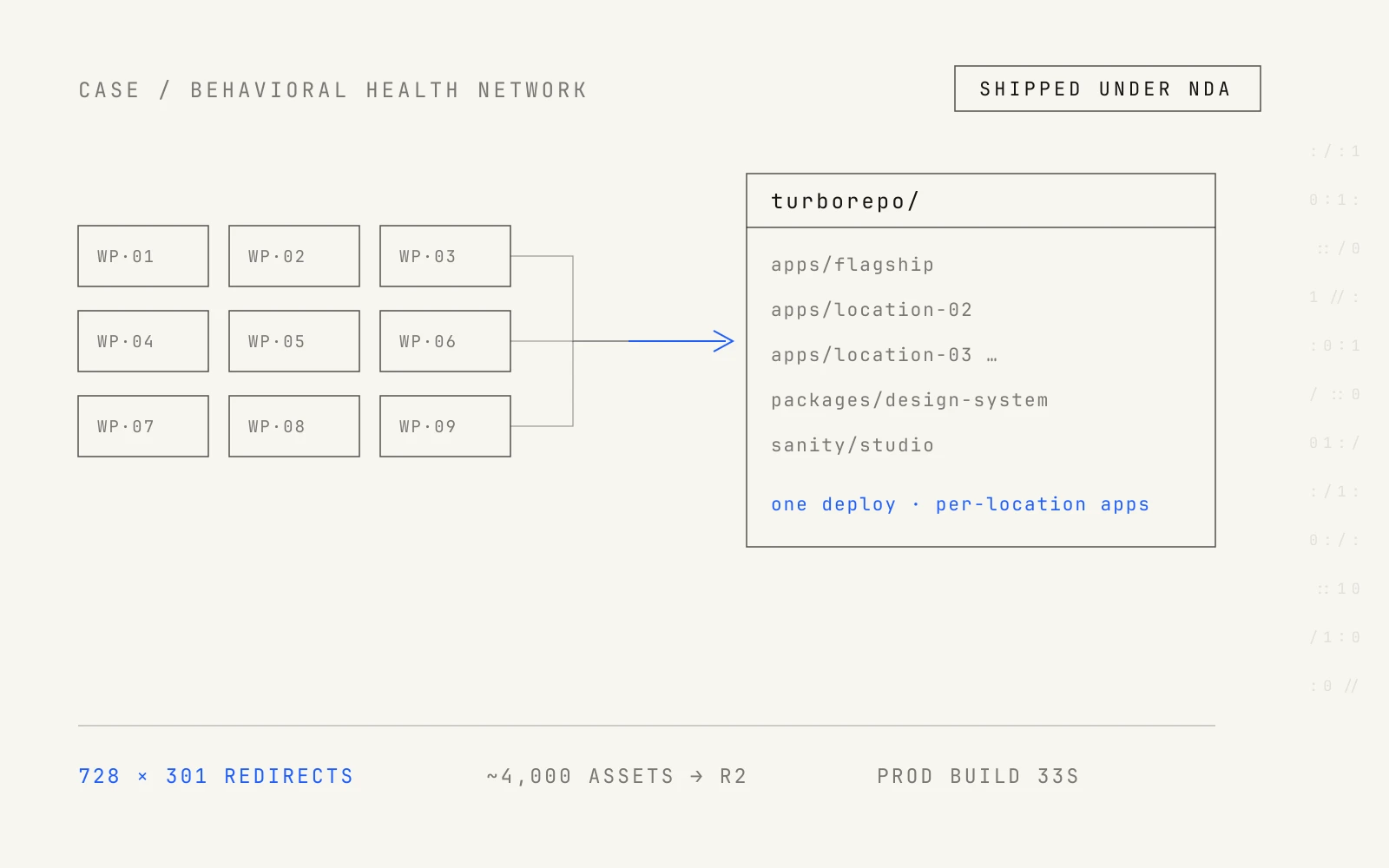
Nine fragmented WordPress sites consolidated into one Turborepo monorepo with a shared design system and 728 mapped redirects.
Read the case TOPSETCreator and buyer accounts, branded storefronts, subscriptions, and automated Stripe revenue splits in one custom product.
Read the case Scenic DoorsA configurator and client portal carrying a quote through approvals, payment, order status, and delivery.
Read the caseEngineering scope
Decisions that survive launch.
The framework is a consequence of the system requirements, operating model, and client ownership, not the headline.
- 01
Architecture & rendering
Define route behavior, data boundaries, caching, and rendering from the application’s actual requirements.
- 02
Content systems
Model content, previews, publishing permissions, and reuse so editorial work does not depend on code changes.
- 03
Deployment & observability
Set up working previews, automated builds, production monitoring, and a deployment path the client can access.
- 04
Multi-site & integration architecture
Share the right code and content across properties while keeping brands, locations, and external systems independently operable.
Delivery controls
Architecture first. Production paths last.
-
Trace the current stack
Map routes, content, integrations, hosting, ownership, and the failure points creating operational drag.
-
Write the architecture
Define the rendering model, content system, integration boundaries, migration controls, and validation plan.
-
Build through previews
Ship working routes and integrations in reviewable stages so decisions happen against the product.
-
Validate and transfer
Run critical production paths, document the system, and confirm access, monitoring, and ownership after launch.
Wrong fit
Do not fund architecture when the need is a content update.
A campaign page, a cosmetic refresh, or an isolated editorial change does not by itself require a full web engineering engagement. This work is useful when the underlying platform, deployment path, content model, or integration layer must change.
Questions
Web engineering decisions, answered.
Scope is driven by the system and its operating constraints. These answers describe the decision process without assuming a universal stack or delivery plan.
Planning a build or rebuild